No Fixed Address Required: How the World's Most Exclusive Resorts Are Becoming Home for the Perpetually Nomadic Elite
There is a particular kind of freedom that only reveals itself once every conventional anchor has been weighed and lifted. For a growing number of America's most affluent individuals — entrepreneurs whose businesses operate entirely in the cloud, investors whose portfolios require no physical proximity to Wall Street, and executives whose organizations function seamlessly across time zones — the idea of a singular home address has begun to feel less like a privilege and more like an arbitrary constraint.
What has emerged in its place is something the hospitality industry is still finding language to describe: a lifestyle architecture built not around a single property but around a carefully assembled constellation of ultra-luxury resorts, each serving as a distinct chapter in a life lived without permanent geographic allegiance. The resorts themselves, sensing both the opportunity and the responsibility, are adapting in ways that reach far deeper than upgraded room categories or extended-stay discounts.
The Guest Who Never Truly Checks Out
The profile of this new long-term resident defies easy categorization. They may spend three months at a coastal property in the Maldives, transition to a mountain sanctuary in the Swiss Alps for the winter season, and settle into a Sonoma wine country estate for the American autumn harvest — all under the umbrella of properties that know their preferences, anticipate their rhythms, and maintain their personal environments with near-domestic precision.
For these guests, the distinction between "staying" and "living" has effectively dissolved. Their dietary preferences are stored not in a single property's system but synchronized across an entire portfolio of affiliated resorts. Their preferred thread count, their morning meditation requirements, their allergy considerations, their preferred vintage of Burgundy — all of it travels with them, invisible and effortless, arriving at each new address before they do.
The leading hospitality groups have begun formalizing what was once handled on an ad hoc basis. Several ultra-luxury collections now offer what might be called a "residential membership" tier — a structure that sits above the traditional loyalty program in both exclusivity and intimacy. Members at this level are assigned a dedicated global liaison, a single point of human contact who manages the continuity of their experience across every property in the network.
Infrastructure Built for Permanence
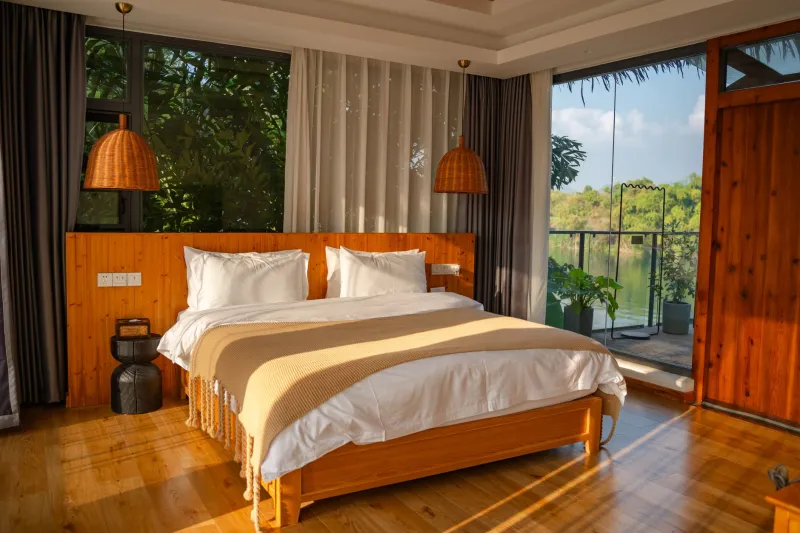
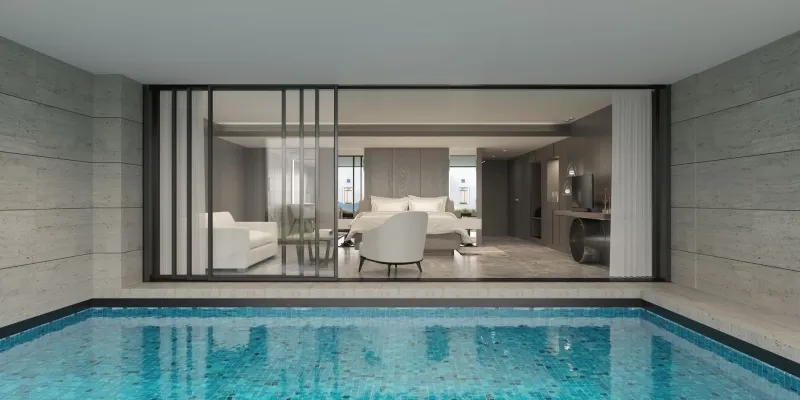
Accommodating a guest who inhabits a suite for four months demands an entirely different operational posture than serving one who arrives for a long weekend. The physical infrastructure of these suites has evolved accordingly. Dedicated storage facilities — climate-controlled, security-accessed, and maintained with the same care as a private residence — allow long-term guests to leave personal effects between visits. Artwork, books, clothing collections, and even musical instruments can remain in place, transforming what was once a hotel room into something far more intimate.
Office infrastructure has become equally non-negotiable. The most forward-thinking properties now offer what their teams privately describe as "embedded workspaces" — not the generic business centers of a prior hospitality era, but fully configured private offices tailored to each guest's professional requirements. Secure broadband, multiple display configurations, soundproofed environments, and on-call technical support are considered baseline amenities for this category of guest.
The culinary dimension has undergone perhaps the most nuanced transformation. A guest residing at a property for an extended period cannot be served from a static menu without the experience degrading into monotony. Executive chefs at properties catering to this market now maintain what some call a "personal culinary archive" — a running record of dishes prepared, preferences noted, seasonal ingredients sourced specifically for individual residents. The goal is not merely satisfaction but the ongoing cultivation of a relationship between guest and kitchen that deepens with each passing week.
The Social Paradox of the Nomadic Elite
Here lies the most delicate challenge these properties must navigate: the long-term resident simultaneously craves profound privacy and meaningful human connection. Isolation without community becomes solitude; community without sanctuary becomes noise. The resorts that are succeeding in this space have developed what might be called a philosophy of curated proximity — engineering social environments where meaningful encounters are possible without ever being obligatory.
Some properties have introduced what they describe as "resident salons" — intimate gatherings convened not around a theme or a scheduled entertainment but around the organic compatibility of the guests currently in residence. A retired senator, a celebrated architect, a pioneering biotech founder, and a novelist of international standing might find themselves sharing a private dinner not because it was arranged for them, but because a perceptive guest experience director recognized the potential for genuine intellectual exchange.
This curatorial instinct — knowing when to facilitate connection and when to protect solitude — has become one of the most prized competencies in elite hospitality. It cannot be automated, and it cannot be scripted. It requires staff who possess something closer to social intelligence than service training, individuals capable of reading the emotional temperature of a resident's day and responding with the appropriate gesture, whether that is a quiet word of introduction or a respectful absence.
Community Across Coordinates
Perhaps the most sophisticated development in this emerging landscape is the cultivation of community that transcends any single property. The networks being built by the most ambitious hospitality groups are designed to ensure that long-term residents encounter familiar faces — fellow travelers of similar sensibility — as they migrate between properties across the globe.
This is not coincidental. Some groups now maintain what amount to informal social directories, with member consent, that allow properties to anticipate compatible guests in residence simultaneously. The result is a kind of moveable community — a social world that reassembles itself in different configurations across different geographies, with the resort serving as the constant and the world itself as the variable backdrop.
For Americans accustomed to building identity around place — the Manhattan apartment, the Hamptons summer house, the Aspen ski chalet — this represents a genuinely novel way of constructing a life. The address is no longer a fixed point on a map. It is, instead, wherever one has chosen to be exceptionally well received.
The Meaning Behind the Movement
What this trend ultimately reflects is a redefinition of belonging itself. For the globally unmoored elite, home is not a coordinate — it is a quality of experience, a standard of care, a consistency of excellence that follows them from one longitude to the next. The most discerning among them are not fleeing from something. They are moving, deliberately and with great intentionality, toward a life in which every morning begins in a place designed to receive them at their finest.
The ultra-luxury resort, in this context, is no longer merely a destination. It has become, for a rarefied few, the very architecture of a life well lived.