The Unscripted Life: Why the World's Most Discerning Travelers Are Dismantling the Curated Experience
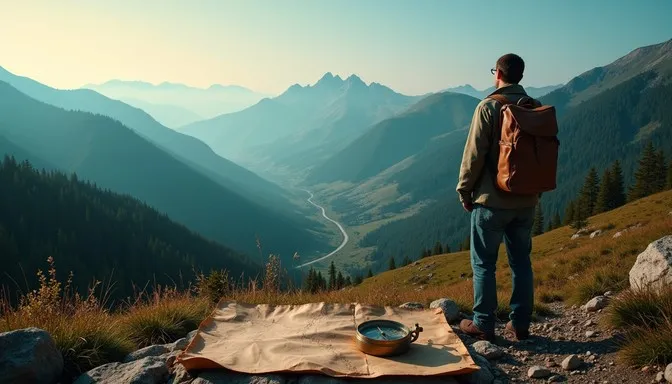
Photo: luxury traveler standing alone at scenic overlook contemplating open landscape, via images.stockcake.com
There is a particular kind of dissatisfaction that only arrives at the highest levels of luxury travel — one that has nothing to do with thread counts, Michelin stars, or the altitude of a private transfer. It is the dissatisfaction of the perfectly orchestrated moment. Of the sunset that was promised, delivered, and photographed exactly as anticipated. Of the local artisan introduced at precisely the right interval of the afternoon. Of the experience, in short, that left no room for surprise.
For a growing cohort of America's most affluent and widely traveled individuals, the curated itinerary — long the gold standard of premium travel — has quietly become its own form of constraint. The very apparatus designed to eliminate friction has, for these travelers, eliminated something far more valuable: the sensation of genuine discovery.
The Paradox at the Heart of Modern Luxury
To understand this shift, one must first appreciate what curated travel accomplished. Over the past two decades, the finest travel advisors and ultra-luxury resorts transformed the art of the itinerary into something approaching choreography. Every element — from pre-arrival amenity selections to post-dinner cultural immersions — was researched, refined, and delivered with an almost architectural precision. For many travelers, this represented the pinnacle of service.
Yet precision, it turns out, has its own ceiling.
The traveler who has experienced a private dinner arranged on the rim of a Sicilian volcano, or a dawn meditation guided by a monk in Kyoto's oldest district, begins to notice something troubling: even the extraordinary, when reliably delivered, begins to feel ordinary. The element of chance — that electric uncertainty that transforms a meal into a memory or a wrong turn into a revelation — has been engineered away. And with it, something essential about what travel was always meant to provide.
"There's a version of luxury travel that's become a very expensive form of being managed," observed one New York-based travel consultant whose clientele includes several of the country's most prominent family offices. "My clients aren't rejecting quality. They're rejecting the feeling that someone else has already decided what their experience means."
Serendipity as a Design Brief
What distinguishes today's most discerning travelers is not a desire to abandon structure entirely — it is a far more nuanced demand. They want the infrastructure of exceptional travel without the predetermined conclusions. They are asking, in essence, for the framework of discovery rather than discovery itself.
This distinction is reshaping how the finest resorts and travel advisors in the world are rethinking their service models. Rather than presenting guests with a completed experience, the most forward-thinking properties are now presenting what might best be described as a landscape of possibility — a curated range of contexts within which the guest retains full agency over direction, depth, and meaning.
A premier resort in the American Southwest, for instance, no longer schedules its wilderness experiences as guided tours with fixed narratives. Instead, it offers guests a private orientation with a naturalist, followed by an entirely open day with provisions, a topographic map, and a satellite communicator. The experience that results belongs entirely to the traveler. The resort's role is not to deliver the story, but to make the story possible.
This is a harder thing to sell than a curated itinerary. It requires a different kind of trust — and a different kind of guest.
The Role of the Advisor Reimagined
For travel advisors who have built their reputations on the flawless execution of detailed programs, this shift demands a fundamental reconsideration of their value proposition. The advisor who once distinguished herself by knowing the best table at every restaurant in Porto must now distinguish herself by knowing which clients should never be given a reservation at all — and which ones need only the name of the neighborhood and the freedom to wander.
The most sought-after advisors in this new landscape function less as architects and more as what one might call contextual strategists. They understand their clients' temperaments, travel histories, and appetites for uncertainty with the intimacy of a long-standing confidant. They know, for example, that a client who thrives on spontaneity in Tokyo may require more scaffolding in Marrakech — not because spontaneity is less valuable there, but because unfamiliarity changes the calculus of what constitutes genuine agency versus disorientation.
The finest advisors are also becoming fluent in the art of the meaningful omission — the deliberate gap left in an itinerary that invites the traveler to fill it themselves. A morning left entirely unscheduled in Lisbon. An afternoon in the Dolomites with no planned activity beyond the name of a trailhead. These are not oversights. They are the most sophisticated elements of the program.
What Resorts Must Now Understand
For properties competing at the highest tier of global hospitality, the implications are significant. The ultra-luxury traveler of 2025 is not arriving at your gates seeking to be impressed. She has been impressed. He has been dazzled, pampered, and presented with experiences of extraordinary technical perfection. What they are now seeking is something that cannot be purchased outright or delivered on a silver tray: the sensation of authorship.
The resorts that are earning the deepest loyalty from this demographic are those that have mastered the art of the enabling environment. They offer exceptional quality at every touchpoint — the food, the accommodations, the staff — while deliberately resisting the impulse to fill every hour with a programmed experience. Their grounds are designed to invite exploration rather than direct it. Their staff are trained to respond to curiosity rather than to initiate it.
This is, paradoxically, a more demanding form of hospitality. It requires a property to trust that its environment is compelling enough to inspire discovery without narration. It requires staff who are as comfortable with silence and open-endedness as they are with formal service protocols. And it requires a leadership philosophy that measures success not by how much was provided, but by how much the guest was moved to seek.
The Deepest Form of Luxury
There is something quietly profound in what this generation of travelers is articulating. In a world saturated with optimization, personalization algorithms, and the relentless efficiency of experience delivery, the most radical act available to the affluent traveler may be the embrace of genuine uncertainty.
To arrive somewhere extraordinary without knowing exactly what will happen next. To make a choice that was not recommended. To be surprised — truly, unexpectedly surprised — by something that no advisor anticipated and no algorithm predicted. This is what the most sophisticated travelers are now paying for, and what the finest properties in the world are learning, with some urgency, to provide.
At Bellapais Deluxe, we have always believed that the finest escapes are not those that execute the expected with precision, but those that expand what the traveler believed possible. The unscripted life, it turns out, is the most luxurious life of all.