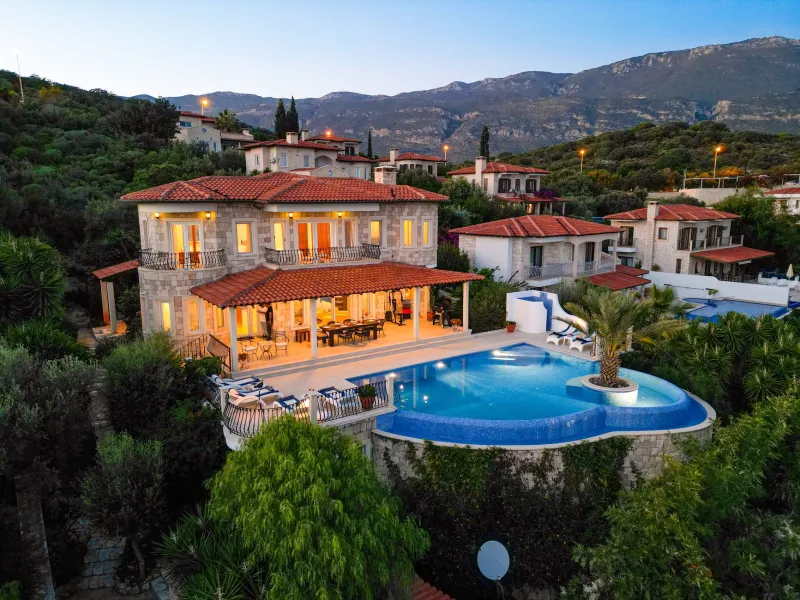
The Architecture of Familiarity: How the World's Most Coveted Resorts Are Designing Spaces That Feel Like a Return
There is a particular sensation that the most devoted luxury travelers describe in strikingly similar terms: stepping across the threshold of a certain property and feeling, inexplicably, as though they have been there before. Not in the sense of recognition — the light is different, the season has shifted, the flowers on the entry table have changed — but in something deeper and more difficult to articulate. A settling. A release. The specific exhale of arriving somewhere that already knows you.
For years, this quality was considered an accident of exceptional hospitality, the rare alchemy of the right staff, the right location, and the right moment in a traveler's life. Today, the world's most forward-thinking resort designers, behavioral architects, and luxury hospitality directors are no longer willing to leave that feeling to chance.
The Science Beneath the Sentiment
Neuroscientists who study spatial cognition have long understood that the human brain processes unfamiliar environments with a low-level vigilance — a primal scanning for threat or disorientation that, while imperceptible in most modern contexts, nonetheless prevents the body from fully releasing into comfort. What the finest resorts are now engineering is an environment that short-circuits that vigilance almost immediately, signaling to the nervous system that this is a place of safety, coherence, and recognition.
The mechanisms are more precise than one might expect. Research into environmental psychology suggests that spatial proportions aligned with domestic scale — ceilings that echo the height of a well-appointed private home rather than a grand hotel atrium, furniture groupings that mirror the intimacy of a personal living room — activate the brain's familiarity circuitry even in first-time visitors. The result is not the awe of a spectacular lobby, but something quieter and ultimately more powerful: the ease of a space that does not demand to be admired.
Several of the world's most acclaimed resort architects have begun consulting directly with neuroscientists during the design phase, calibrating everything from the radius of curved corridors to the temperature of ambient lighting at specific hours of the day. The goal, as one leading designer based in Milan described it, is to build environments where the guest's body arrives before their conscious mind does.
The Material Language of Belonging
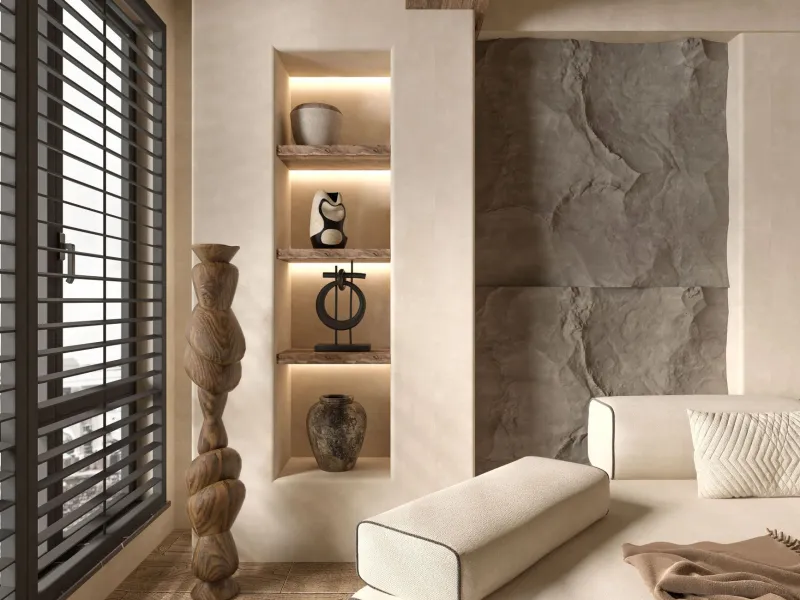
Beyond proportion and scale, the materials themselves carry tremendous psychological weight. Ultra-luxury resorts at the vanguard of this movement are deliberately moving away from the polished, the pristine, and the visually dominant — the marble expanses and mirrored surfaces that signal luxury through spectacle — toward materials that carry the patina of time and use. Reclaimed wood with visible grain. Stone sourced from the local landscape. Textiles that bear the subtle irregularities of handcraft.
These choices are not merely aesthetic. They are neurological. The brain interprets worn, textured, locally sourced materials as evidence of history — and history, in turn, is a proxy for belonging. When a guest runs their hand along a centuries-old timber beam in a suite in the Dolomites, or sinks into a linen whose weave carries the slight imperfection of a regional atelier, the subconscious reads those details as markers of a place that has existed before them and will exist after them. They are not the first. They will not be the last. And somehow, that continuity is profoundly comforting.
Properties in the American Southwest have taken this principle even further, partnering with Indigenous artists and craftspeople to integrate materials and motifs that carry genuine ancestral meaning into their guest environments. The result is not decoration, but narrative — spaces that tell a story deep enough for guests to find their own place within it.
The Service Philosophy of Preemptive Intimacy
Physical design, however sophisticated, can only carry a guest so far. The most transformative properties understand that the architecture of belonging extends to the human dimension of the experience — and that the staff are, in a very real sense, the living structure of that feeling.
The service philosophy at these properties has evolved well beyond anticipatory hospitality into something their directors describe as preemptive intimacy. Guest intelligence is gathered not through intrusive data collection but through careful, cumulative observation across multiple stays — and, increasingly, through thoughtful pre-arrival conversations conducted by dedicated relationship managers who take the time to understand not just preferences but rhythms. Does this guest prefer silence in the morning? Do they read on the terrace before dinner? Do they require a particular quality of darkness to sleep?
When those details are woven invisibly into the fabric of a stay — when the morning coffee appears without request, when the terrace cushions are arranged precisely as the guest had them last time, when the room temperature has already been adjusted before the key is turned — the effect is not one of impressive efficiency. It is one of being known. And being known, for the ultra-wealthy traveler who has experienced every form of material luxury, is perhaps the rarest offering of all.
Why the Ultra-Wealthy Keep Returning
Among the most affluent American travelers, loyalty to a specific property has become one of the defining markers of sophisticated taste. Where earlier generations of luxury travelers measured their discernment by the breadth of their itineraries — the number of new destinations claimed, the diversity of properties sampled — today's most thoughtful travelers are increasingly distinguished by their depth of return.
The resorts that inspire this devotion share a common quality: they do not merely accommodate their guests. They accumulate them. Each stay adds another layer to a relationship that, over time, begins to resemble something genuinely personal. Staff members remember not just preferences but conversations. The property itself seems to shift subtly to receive a returning guest — a suite repositioned, a private dining arrangement made without prompting, a welcome that references the last visit with the warmth of genuine recollection.
For many guests, this accumulation becomes the point of the travel itself. They are not returning to a hotel. They are returning to a version of themselves — one that exists only in that particular combination of place, atmosphere, and human connection.
The Geometry of Belonging, Realized
What emerges from this confluence of neuroscience, material philosophy, and service design is something that the hospitality industry is only beginning to find language for. The most compelling term, perhaps, is one borrowed from architecture itself: the idea of a space that has been calibrated not just for beauty or function, but for resonance.
A resonant space is one that vibrates at a frequency the guest already carries within them — one that meets them where they are rather than asking them to rise to meet it. It is, in the end, the opposite of a grand statement. It is a quiet recognition.
For the traveler who has seen everything and stayed everywhere, that recognition — arriving somewhere new and feeling, with complete certainty, that you belong there — is the most extraordinary luxury of all.