The Art of Doing Nothing: How the World's Most Affluent Travelers Are Discovering That True Luxury Begins When the Itinerary Ends
For decades, the architecture of luxury travel has been built upon a single, unspoken assumption: that the affluent traveler arrives hungry. Hungry for novelty, for access, for the kind of orchestrated wonder that justifies the investment and, perhaps more critically, the story told afterward. The finest resorts on earth have competed fiercely on the density of their programming—the private chef who sources ingredients from a sunrise market, the helicopter transfer to a glacier few have touched, the sommelier who pairs each course with a narrative as carefully constructed as the wine itself.
And yet, something is shifting in the most rarefied corridors of global hospitality. Quietly, almost imperceptibly, the conversation among America's most sophisticated travelers has begun to turn toward a different kind of desire entirely.
They are, increasingly, seeking the luxury of nothing.
The Exhaustion Beneath the Excellence
To understand this shift, one must first appreciate the particular fatigue that accompanies a life constructed almost entirely of peak experiences. For the ultra-wealthy American traveler—executives managing global enterprises, founders navigating the perpetual demands of scaling companies, professionals whose calendars are instruments of precision—the waking hours are rarely unoccupied. Every moment, whether professional or recreational, tends to carry weight, expectation, and some form of performance.
Even travel, ostensibly the great escape, has not been immune to this dynamic. The rise of social documentation has transformed experience into content. The proliferation of ultra-exclusive access has made scarcity itself a competitive sport. And the hospitality industry, eager to justify premium price points, has filled every available hour with something worth doing, somewhere worth being, someone worth impressing.
The result, for a growing cohort of discerning travelers, is a profound and somewhat ironic exhaustion. They arrive at the world's finest properties already full—and they leave, if they are honest, not entirely rested.
Redefining the Premium Experience
What the most perceptive voices in luxury hospitality are beginning to recognize is that genuine rest—not the performative version staged around a pool with a curated cocktail, but the deep, structureless kind that arrives only when all expectation has been removed—has become genuinely scarce. And scarcity, as any student of luxury well understands, is the precondition of desire.
A handful of forward-thinking properties have begun to architect their offerings around this insight with remarkable intentionality. Rather than competing on the volume or exclusivity of their programming, they are competing on the quality of their emptiness. Long, uninterrupted stretches of time. Rooms designed not merely for sleep but for the particular pleasure of remaining horizontal past any reasonable hour. Grounds that invite wandering without destination. Staff trained in the sophisticated art of being present without prompting.
The proposition, stated plainly, sounds almost absurd: pay handsomely to have nothing arranged for you. And yet, for the traveler who has had everything arranged, this is precisely what resonates.
The Architecture of Unstructured Time
Designing for boredom—a word that deserves rehabilitation in this context—requires a different kind of hospitality intelligence. It is not enough to simply remove the activity schedule and hope for the best. True restorative luxury demands that the environment itself carry the experience, that the quality of light through a window, the weight of silence in a garden, the temperature of an afternoon breeze, all conspire to make the absence of agenda feel not like deprivation but like abundance.
This is, in many ways, a more demanding design challenge than the orchestrated moment. The choreographed experience has a beginning, a middle, and a satisfying conclusion. The unstructured afternoon asks more of the space, the material quality, and the atmosphere. There is nowhere to hide behind programming.
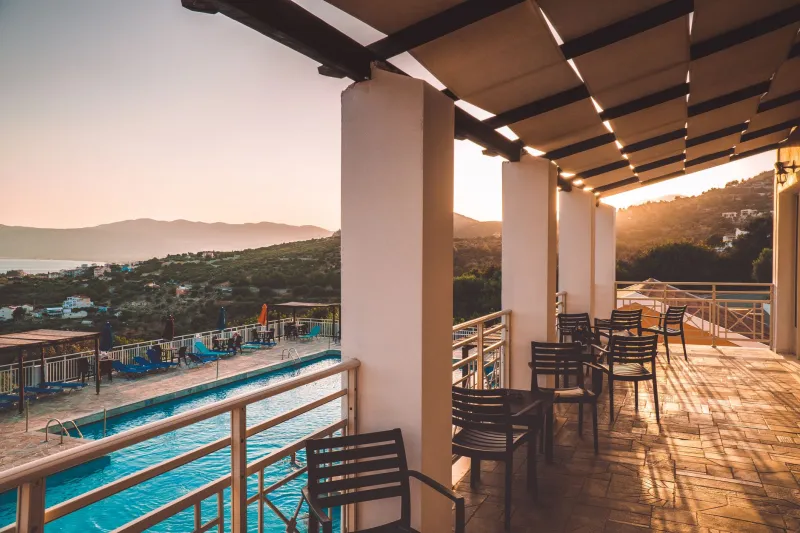
Properties meeting this challenge tend to share certain characteristics. They occupy landscapes of inherent, unhurried beauty—coastlines that reward long looking, hillsides where the horizon does the work. They invest heavily in the physical quality of repose: beds that earn their thread counts, terraces that understand the geometry of shade, bathing facilities that transform the ordinary ritual of washing into an extended contemplation. They train their teams to read the particular language of a guest who wishes to be left entirely alone—and to honor that language fluently.
The Social Permission Problem
Perhaps the most interesting dimension of this trend is what it reveals about the social pressures that have quietly colonized even the most privileged forms of leisure. For many high-achieving American travelers, the difficulty of doing nothing is not logistical. It is psychological. The internal architecture of a life built on productivity and measurable output does not simply dissolve upon check-in.
This is why the most sophisticated resorts are beginning to understand that they must provide not just the conditions for rest, but something approaching permission for it. The framing matters enormously. When a property communicates, through its design philosophy, its staff culture, and its explicit messaging, that presence without agenda is not merely acceptable but genuinely valued—that there is nothing to accomplish, no experience to optimize, no moment to document—something releases in even the most driven guest.
Some properties accomplish this through deliberate digital minimalism, not merely offering the option to disconnect but subtly architecting an environment where connectivity feels beside the point. Others invest in the quality of their communal silence—reading rooms, contemplative gardens, dining formats that do not demand social performance. The most thoughtful among them recognize that the guest who spends three days doing almost nothing and leaves feeling restored has had, in the truest sense, a transformative experience.
The Status of Stillness
There is, of course, a certain irony in the observation that doing nothing has become the newest marker of sophisticated taste. Status has always been, in part, a function of access to what others cannot obtain. For generations, that calculus favored the extraordinary experience, the impossible reservation, the destination known only to those with the right connections.
But when extraordinary experiences have become sufficiently accessible to anyone with sufficient capital, the truly extraordinary thing becomes something else entirely. It becomes the afternoon with no obligations. The morning that belongs to no one. The week in which nothing of consequence is accomplished, and nothing is required to be.
For the traveler who has genuinely had everything, the freedom to have nothing may be the most extravagant proposition of all.
The finest properties in the world are beginning to understand this. They are learning to sell not the promise of more, but the profound, almost transgressive pleasure of less—less stimulation, less documentation, less performance, less of everything except the rare and quietly radical experience of simply being present in a beautiful place with no particular reason to be anywhere else.
In the long history of luxury, few things have been harder to come by.