Before the Wheels Touch Down: How Bespoke Aviation Is Rewriting the Prelude to Luxury Travel
There is a particular kind of traveler who refuses to compartmentalize the journey. For them, the experience of arriving somewhere magnificent is not a logistical burden to be endured before the real pleasure begins — it is, in every meaningful sense, the opening movement of something far grander. And increasingly, the world's finest aviation and hospitality brands are building entire ecosystems around this philosophy.
The private jet terminal, once regarded as little more than a convenient bypass of commercial airport chaos, has evolved into something far more deliberate. It is now, for those who know how to use it, the first act of a carefully orchestrated production.
The Terminal as Threshold
Fixed-base operators — the private aviation facilities that serve as departure and arrival lounges for charter and fractional ownership clients — have undergone a quiet but significant transformation over the past several years. What were once functional spaces defined by comfortable seating and decent espresso have become curated environments designed to signal, from the very first moment, that what follows will be exceptional.
Facilities at major U.S. departure hubs such as Teterboro in New Jersey, Van Nuys in California, and Signature Flight Support locations across the country now offer amenities that rival boutique hotel lobbies: private suites for pre-departure relaxation, temperature-controlled wine service, and on-site chefs capable of preparing customized meals timed precisely to departure. The emphasis is on seamlessness — the sense that one has stepped out of the ordinary world entirely, long before the aircraft has left the ground.
Brands such as Wheels Up and Flexjet have invested considerably in what the industry quietly calls "departure experience design," a discipline that treats the thirty to ninety minutes before boarding not as dead time but as prime hospitality real estate. For clients traveling to ultra-luxury resorts in destinations such as St. Barts, the Maldives, or the Amalfi Coast, the pre-departure ritual is coordinated directly with the destination property — ensuring that dietary preferences, preferred cabin temperature, and even the passenger's choice of reading material are aligned across every touchpoint.
The Invisible Handoff
Perhaps the most sophisticated element of this new aviation culture is what industry professionals refer to as the "invisible handoff" — the seamless transfer of guest intelligence between the aviation provider, ground transportation service, and destination resort. When executed with precision, the traveler experiences no friction whatsoever. Preferences communicated once are honored everywhere, without the guest ever needing to repeat themselves.
This coordination requires a level of inter-organizational communication that, until recently, simply did not exist at scale. Today, dedicated travel architects — a role that blends the traditional functions of a personal assistant, concierge, and logistics director — manage these transitions on behalf of their clients. Firms such as Quintessentially Travel and Indagare have built their reputations, in part, on their ability to orchestrate exactly this kind of invisible choreography.
The ground transportation component deserves particular attention. The vehicle that meets a traveler on the tarmac is no longer simply a car. It is, for the most thoughtful operators, an extension of both the aircraft cabin and the resort suite. Chilled towels, locally sourced refreshments, curated music selections, and even bespoke fragrances — chosen to evoke the destination before arrival — are now standard offerings among the most discerning ground transportation providers. Companies serving luxury resort corridors in destinations such as Tuscany, Bali, and the Caribbean have begun collaborating directly with properties to ensure that the drive from the airstrip is as considered as any moment spent on the property itself.
Personalization at Altitude
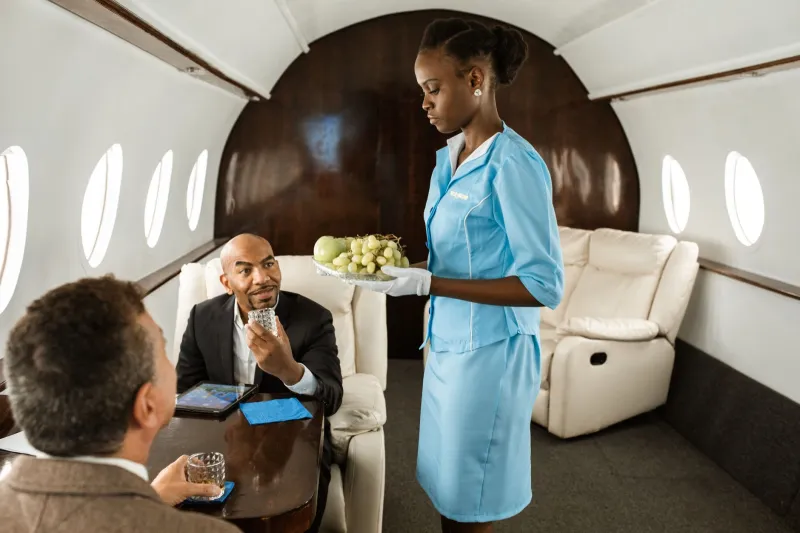
Within the aircraft cabin, the evolution has been equally pronounced. The days of generic charter interiors — beige leather, stock glassware, a wine list that could belong to anyone — are giving way to something far more intentional. Leading charter operators now offer cabin customization as a standard part of the booking process, allowing travelers to specify everything from the thread count of cabin linens to the provenance of the cheese board.
For longer transatlantic or transpacific routes, operators such as VistaJet have introduced what might be described as in-flight lifestyle curation: partnerships with Michelin-starred chefs, access to rare wine libraries, and wellness programming that includes guided meditation, sleep optimization protocols, and skincare regimens designed to counteract the dehydrating effects of high-altitude travel. The goal, articulated with refreshing directness by several operators, is to ensure that guests arrive at their destination feeling as well-rested and composed as they were when they departed.
This attention to the physiological dimensions of long-haul travel reflects a broader understanding among luxury aviation brands: that the body's condition upon arrival is itself a form of hospitality. Arriving depleted, disoriented, or stiff is, in this view, a failure of the experience — regardless of how beautiful the destination may be.
When the Resort Begins Before the Resort
The most forward-thinking luxury properties have recognized that the guest experience does not begin at check-in. It begins at the moment of departure from home, and perhaps even earlier — at the point of reservation, when anticipation first takes hold. Several ultra-luxury resorts have begun extending their signature service philosophies into the aviation and ground transportation phase, deploying property staff or branded representatives to meet guests at the terminal, presenting welcome gifts that preview the destination's aesthetic, and offering a first taste of the resort's culinary identity in the form of artisanal provisions for the journey.
This philosophy — that the destination itself should reach out to greet the traveler mid-journey — represents a meaningful shift in how luxury hospitality is conceptualized. The resort, in this model, is not a place one arrives at. It is an experience that unfolds continuously, beginning hours before one ever sees the property.
The Measure of a Seamless Journey
For affluent American travelers who have grown accustomed to excellence at the destination, the journey itself has become the new frontier of expectation. The question is no longer simply whether the resort is extraordinary — it is whether every moment leading to the resort reflects the same standard of care and intentionality.
The brands that have understood this — and built their offerings accordingly — are not merely selling transportation. They are selling continuity: the assurance that the quality of one's experience will never dip, never falter, never remind the traveler that they are, in any prosaic sense, simply getting from one place to another.
In the most refined iteration of modern luxury travel, there is no such thing as transit. There is only the experience, unfolding.