The Glorious Flaw: How Affluent Travelers Are Falling in Love With Imperfect Luxury
There is a particular kind of magic that no five-star training manual can manufacture. It happens when the innkeeper's elderly dog wanders into the breakfast room uninvited, or when a sommelier abandons the approved wine-pairing script to confess, with conspiratorial delight, that the house's second-label Burgundy is quietly superior to the flagship bottle. These moments — unscripted, unrepeatable, and entirely human — have become, for a growing segment of America's most affluent travelers, the most coveted currency in modern luxury hospitality.
For decades, the luxury travel industry pursued a singular vision of excellence: seamless arrivals, geometrically precise turndowns, and staff trained to anticipate every conceivable desire before it was uttered. That standard, formidable as it remains, no longer satisfies the way it once did. Something has shifted, and the most perceptive hoteliers in the world are paying close attention.
The Fatigue of Perfection
American luxury travelers, particularly those who have accumulated decades of five-star stays across multiple continents, have begun to articulate a curious dissatisfaction — not with the quality of the experience, but with its texture. The thread count is impeccable. The concierge response time is instantaneous. The plating at dinner is architecturally flawless. And yet, something essential is missing.
Psychologists who study high-net-worth consumer behavior describe this phenomenon as "peak polish fatigue" — a gradual desensitization to orchestrated perfection that leaves even the most lavish experience feeling curiously hollow. When every moment has been engineered, the traveler becomes, in a sense, a spectator of their own vacation rather than a participant in it. The surprise has been eliminated alongside the imperfection, and with it goes the sense of discovery that travel, at its most elemental, is meant to provide.
This is not a rejection of quality. It is a refinement of what quality actually means.
The Rise of the Intentionally Human Property
Forward-thinking hoteliers have begun responding to this appetite with a deliberate recalibration of their service philosophy. Across the American West, the Italian countryside, and the boutique hotel corridors of coastal New England, a new archetype is emerging: the luxury property that celebrates, rather than conceals, its human dimensions.
Consider the small-scale properties — often family-owned for multiple generations — that have quietly built cult followings among sophisticated American travelers precisely because of their refusal to homogenize. The patriarch who insists on personally recommending hiking trails based on a guest's stated mood. The housekeeper who leaves handwritten notes rather than printed cards. The chef who emerges from the kitchen not for a choreographed tableside appearance, but because he genuinely wants to know whether the sauce landed as intended.
These gestures cannot be systematized. That is, entirely, the point.
Some properties are going further still, actively resisting the industry's drift toward algorithm-driven personalization. Where many luxury hotels now rely on data profiles to anticipate guest preferences, a countermovement of boutique operators is insisting that the more meaningful approach is simply to ask — and then to listen with genuine curiosity rather than transactional efficiency.
What "Authentic" Actually Costs
The authenticity premium is not, it should be noted, a budget proposition. The most coveted of these human-scale experiences frequently command rates that rival or surpass those of their polished corporate counterparts. What has changed is not the price of admission but the nature of the value being delivered.
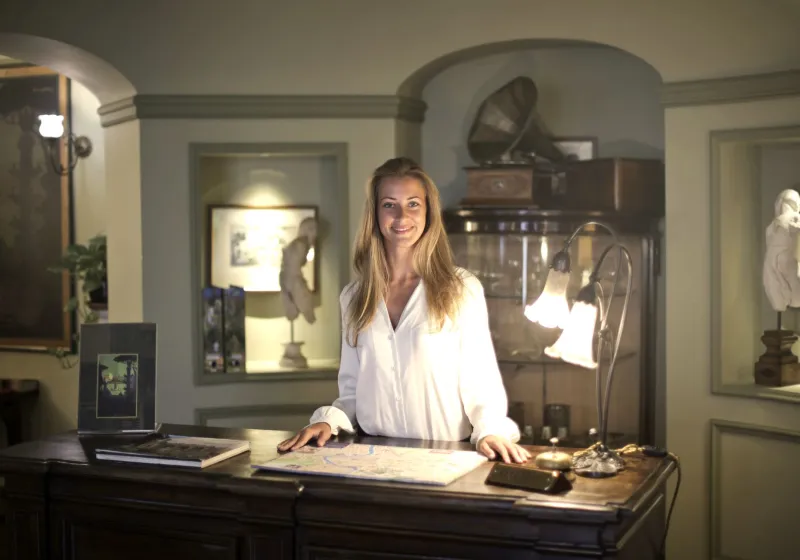
American travelers with the means to stay anywhere are increasingly willing to accept a slightly uneven cobblestone path, a breakfast room that smells of last night's wood fire, or a check-in process that involves a genuine conversation about the week ahead rather than a swift digital transaction. These are not failures of service; they are, to the discerning eye, evidence of a property that has resisted the pressure to sand away everything interesting about itself.
The irony is not lost on industry observers: the pursuit of authentic imperfection has itself become something of a luxury signal. The traveler who chooses the characterful inn over the gleaming resort tower is making a statement about the sophistication of their own palate — one that no amount of marble lobby can replicate.
Staff as Storytellers, Not Automatons
Perhaps the most significant dimension of this trend concerns the people who deliver the experience. In the traditional luxury model, staff members are trained to maintain a certain professional remove — warm but not familiar, helpful but never intrusive. The new authenticity-forward properties are actively dismantling this convention.
The most celebrated examples are places where the front-of-house team is encouraged to bring genuine personality to their interactions. A bartender who shares her own favorite neighborhood restaurant rather than defaulting to the property's approved referral list. A guide who admits freely when a trail is underwhelming and redirects accordingly. A manager who sits down with a longtime guest, not to solicit feedback, but simply to talk.
These interactions require a different kind of training — one built around trust, judgment, and the confidence to be present as a full human being rather than a service function. The luxury properties that have mastered this balance are discovering that guests do not merely return; they form genuine attachments to the people and places that treated them as something more than a valued client.
The Paradox at the Heart of Modern Luxury
There is a productive tension embedded in all of this. The authenticity that affluent travelers now seek cannot be manufactured on demand — and yet the hospitality industry's instinct is always to identify a trend and systematize it. The risk is obvious: an "authentic imperfection" that has been carefully staged by a brand consultant is, of course, neither authentic nor particularly imperfect.
The properties navigating this paradox most gracefully are those that have understood authenticity not as a design principle to be applied, but as a culture to be cultivated. It begins with hiring people who are genuinely curious about guests, then trusting them to act on that curiosity. It continues with physical spaces that bear the honest marks of their history rather than concealing them beneath renovation layers. It sustains itself through a willingness to let some things remain unpredictable.
For the American luxury traveler who has, in some sense, seen everything, this unpredictability has become the rarest amenity of all. The perfectly pressed pillow will always be available, at the right price, anywhere in the world. The innkeeper who remembers your grandmother's name from a conversation three years ago — that is something no amount of operational excellence can replicate.
And increasingly, that is precisely what discerning travelers are willing to travel the farthest to find.