Where Walls Become Galleries: The Luxury Resorts Redefining Hospitality Through Living Art
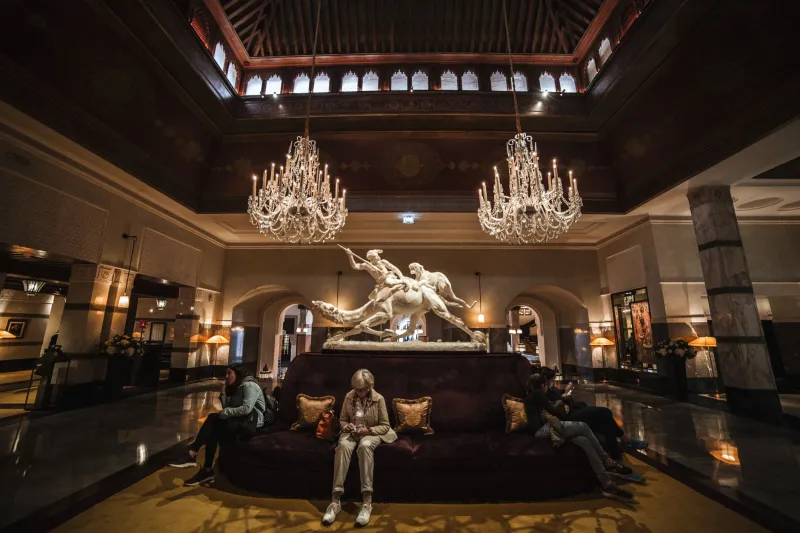
The lobby of a celebrated resort in New Mexico's high desert contains, among its permanent holdings, a large-scale painting by an artist whose work last sold at Christie's for north of three million dollars. It hangs not behind glass or security barriers, but at eye level, accessible to any guest who wanders through after breakfast. No placard urges caution. No velvet rope maintains a respectful distance. The work simply exists in the space, breathing alongside the people who move through it, as natural and unhurried as the light that falls across it each morning from the clerestory windows above.
This is not an accident of interior design. It is a curatorial philosophy — one that an expanding cohort of ultra-luxury hospitality properties across the United States and abroad has embraced with remarkable seriousness and, it must be said, remarkable investment.
From Decoration to Declaration
For much of the twentieth century, art in luxury hotels served a familiar and largely decorative function. Large canvases filled lobby walls. Sculptures occupied corners. The work was often accomplished, occasionally notable, but fundamentally subordinate to the architecture and the atmosphere it was meant to enhance. Art was backdrop. Hospitality was foreground.
What has emerged in the past decade represents a fundamental inversion of that hierarchy. A growing number of properties have repositioned art not as an amenity but as an identity — the organizing principle around which every other aspect of the guest experience is designed. These are not hotels that happen to display art. They are, in the most meaningful sense, cultural institutions that happen to offer accommodations.
The distinction matters enormously to the guests who seek them out. For the affluent American traveler who moves through the world's great cities with museum memberships and gallery relationships already in hand, a resort that offers genuine curatorial depth represents something genuinely novel: the integration of aesthetic engagement into the rhythms of daily life, without the formality or the schedule that a traditional cultural institution demands.
The Curator in Residence
At the vanguard of this movement are properties that have hired dedicated curatorial staff — professionals with museum and gallery backgrounds who approach their role with the same rigor they would bring to a major institutional collection. Their responsibilities extend well beyond acquisition. They manage relationships with living artists, develop interpretive programming, oversee conservation, and shape the ongoing dialogue between the collection and the guests who encounter it.
One such curator, who oversees the collection at a celebrated coastal property in California's Big Sur corridor, describes her mandate as fundamentally different from that of a museum counterpart. "In a museum, the art is the destination," she explains. "Here, the art is the companion. It travels through the day with our guests — at breakfast, on the path to the spa, at dinner. We are asking it to do something more intimate and more continuous than a museum ever could."
That intimacy is, by all accounts, the point. Several properties have structured their collections so that specific works are placed in the spaces where guests are most psychologically receptive — a contemplative sculpture beside the morning meditation terrace, a kinetic installation near the pool where the energy of moving water and moving light create a natural dialogue. The curation is not merely aesthetic. It is, in the most deliberate sense, experiential.
Artist Residencies and the Living Collection
Perhaps the most ambitious expression of this trend is the artist residency program, which a number of ultra-luxury properties have established as a cornerstone of their cultural identity. Under these arrangements, working artists — painters, sculptors, ceramicists, photographers, composers — spend extended periods at the property, creating new work in purpose-built studios while remaining accessible, to a carefully calibrated degree, to the guests around them.
The model is not without precedent. Artist colonies have existed in the American landscape since the late nineteenth century, from the MacDowell Colony in New Hampshire to the Taos art community in New Mexico. What distinguishes the luxury hospitality iteration is the quality of the physical environment, the caliber of the artists invited, and the deliberate integration of the creative process into the guest experience.
At a resort in the Hudson Valley, guests may observe — through large studio windows, or during scheduled open-studio hours — an artist at work on a commission that will ultimately become part of the property's permanent collection. The transaction is transparent and, for many guests, profoundly affecting. To witness the creation of a work that will outlast any individual visit, in a place of uncommon beauty, is to participate, however peripherally, in something with genuine cultural stakes.
Some properties have taken the residency concept further still, offering guests the opportunity to engage directly with visiting artists through private studio conversations, collaborative workshops, or curated dinners at which the artist is present not as a performer but as a fellow traveler — someone whose perspective on the landscape, the light, and the particular quality of the place enriches the conversation at the table.
Bespoke Cultural Programming as Competitive Advantage
Beyond collections and residencies, the properties leading this movement have developed cultural programming calendars of considerable ambition. Visiting scholars deliver intimate lectures in the library. Chamber ensembles perform in acoustically considered spaces. Textile artists lead workshops using materials sourced from the surrounding region. Film curators assemble evening screenings of works that resonate with the property's aesthetic DNA.
This programming is not incidental. It is, for the creative directors who design it, a primary expression of the property's identity — and a meaningful differentiator in a luxury travel market where the conventional markers of excellence (the quality of the linens, the depth of the wine cellar, the responsiveness of the concierge) have become largely standardized among properties at the highest tier.
"Anyone can offer a beautiful room," notes the cultural director of a celebrated resort in the Sonoran Desert, where the programming calendar is developed in collaboration with a regional arts foundation. "What we are offering is a reason to be moved. That is a different proposition entirely."
The New Measure of Luxury Sophistication
For the discerning American traveler, the rise of the art-forward resort signals something significant about the evolving definition of luxury itself. The generation of affluent travelers now driving the premium end of the hospitality market has, in many cases, already acquired the material markers of success. What they seek in travel is not confirmation of status but expansion of experience — encounters with beauty, ideas, and creativity that they cannot engineer at home, regardless of their resources.
A resort that offers a genuinely curated cultural experience, staffed by people with deep expertise and animated by a coherent aesthetic vision, speaks directly to that aspiration. It offers not merely a place to rest, but a place to be enlarged — to leave with something that has no price tag and no expiration date.
In that sense, the finest art-forward resorts are doing precisely what the greatest works in their collections have always done: they are asking their visitors to see the world, if only for a moment, with greater clarity and greater wonder than they arrived with.