The Threshold Moment: How the World's Finest Hotels Are Transforming Arrival Into an Act of Becoming
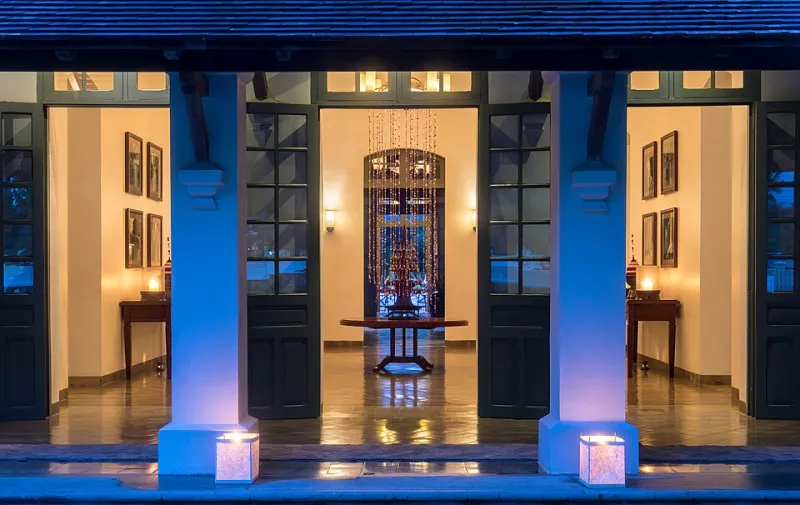
Photo: Basile Morin, CC BY-SA 4.0, via Wikimedia Commons
There is a particular kind of traveler who has grown quietly dissatisfied with the conventional hotel lobby. Not because the marble is less lustrous or the flower arrangements less extravagant, but because the experience — however opulent — has begun to feel like a transaction dressed in finery. Luggage is received. Keys are exchanged. A welcome drink materializes. And then, almost imperceptibly, an opportunity is lost.
For those who travel not merely to occupy space but to be genuinely altered by it, the lobby has become the most consequential room in any property. It is, at its most essential, a threshold — a liminal zone between the world one has left and the world one is about to inhabit. And the most forward-thinking luxury properties on earth are now treating it with precisely that philosophical weight.
Beyond the Grand Foyer
The traditional luxury lobby was designed, above all else, to impress. Soaring ceilings, imported stone, the careful choreography of uniformed staff — these were the signals that told a guest they had arrived somewhere worthy of their ambitions. That language of grandeur still resonates, but it no longer satisfies alone.
What has shifted is the expectation of meaning. America's most affluent travelers — a cohort increasingly fluent in the vocabulary of experiential depth — are no longer content to be impressed. They wish to be met. The distinction is significant. To be impressed is to receive a performance. To be met is to be recognized, acknowledged, and drawn forward into something that feels personal rather than procedural.
Several of the world's most celebrated properties have begun to architect their arrival sequences around this psychological distinction. At one celebrated resort along the Adriatic coast, guests are greeted not at a reception desk but in a private garden anteroom, where a single staff member — assigned exclusively to that guest for the duration of their stay — offers a brief, unhurried conversation designed to calibrate the emotional register of the visit. No forms. No key cards visible. Simply a human exchange that signals, unmistakably, that this place has been waiting for you.
Sensory Sequencing as Hospitality Philosophy
The most sophisticated arrival experiences are not improvised. They are composed — layered with the same intentionality a conductor brings to an opening movement. Scent, sound, temperature, light, and texture are each considered as instruments in an orchestrated welcome.
Leading hospitality consultants have noted a marked increase in properties commissioning bespoke olfactory profiles for their entrance spaces — not generic floral diffusions, but site-specific fragrances developed in collaboration with master perfumers, designed to evoke the character of the surrounding landscape. A coastal property might carry the faintest suggestion of salt air and sun-warmed stone. A mountain retreat might offer something drier, resinous, almost meditative.
Sound design has emerged as an equally deliberate element. Rather than ambient music selected for inoffensiveness, some properties now work with acoustic architects to ensure that the soundscape of arrival — whether the distant murmur of water, the measured resonance of a particular timber floor, or the specific quality of outdoor silence that filters through a carefully positioned entrance — speaks to the emotional identity of the place before a single word is exchanged.
The Psychology of the Pause
Perhaps the most radical innovation in elite arrival design is also the most counterintuitive: the deliberate introduction of stillness. In an era defined by velocity, a handful of properties have begun to engineer what might be called a decompression interval — a brief, intentional pause built into the arrival sequence that invites guests to shed the momentum of transit before stepping fully into the experience that awaits.
This might take the form of a private courtyard where a guest is invited to sit for a few minutes with a single, exceptional cup of something — tea, coffee, or a house-made botanical elixir — before proceeding to their accommodations. It might be a short walk through a garden designed not for spectacle but for quietude, the path itself a kind of punctuation between what was and what is about to be.
The psychological rationale is well-founded. Neuroscientific research has increasingly affirmed what intuitive hoteliers have long suspected: that the brain requires a transitional period to shift from a state of alertness — the vigilance required by airports, travel logistics, and the general friction of movement — to the receptive openness that allows genuine pleasure to register. Properties that honor this transition find that guests rate their overall experience more favorably, not because any single element was superior, but because they were emotionally prepared to receive it.
Arrival as Editorial Statement
For the most architecturally ambitious properties, the lobby itself has become a curatorial act — a first chapter that announces, with clarity and confidence, the aesthetic and philosophical world the guest is entering. This is a departure from the historical model in which lobbies were designed to appeal broadly, to offend no one, to present luxury as a kind of universal grammar.
The new approach is more authoritative. Properties designed with a strong editorial point of view — whether rooted in regional craft traditions, contemporary art, biophilic design, or a particular interpretation of local history — use the arrival space to make that perspective legible immediately. The guest who walks into such a lobby understands, within moments, that they have entered a world with convictions. And there is something profoundly reassuring about that — a sense that one is in the hands of people who know exactly what they are doing and why.
For American travelers accustomed to the studied neutrality of even the most expensive hotel chains, this quality of editorial commitment can feel startling, even intimate. It requires a kind of reciprocal openness — a willingness to be led somewhere specific rather than simply accommodated in the abstract.
The First Impression as Lasting Architecture
What the finest properties understand — and what the broader industry is slowly beginning to absorb — is that the arrival experience does not merely precede the stay. It structures it. The emotional and sensory impressions formed in those first minutes establish a framework through which every subsequent experience is interpreted. A guest who arrives feeling genuinely welcomed, aesthetically engaged, and psychologically settled will encounter the remainder of the property through a lens of openness and appreciation. A guest who arrives feeling processed, however efficiently, will spend the first day or two quietly recalibrating.
The implications for luxury hospitality are significant. The lobby, long regarded as a transitional space — a necessary corridor between the street and the suite — is being reconceived as perhaps the most important room in the building. Not because it is the grandest, but because it is where the relationship between guest and place is first established, and where the possibility of genuine transformation either opens or quietly closes.
For those who travel in pursuit of something more than comfort — who seek, however obliquely, to return home slightly different from how they departed — the threshold moment has become everything. And the world's most discerning properties are finally designing to meet them there.